
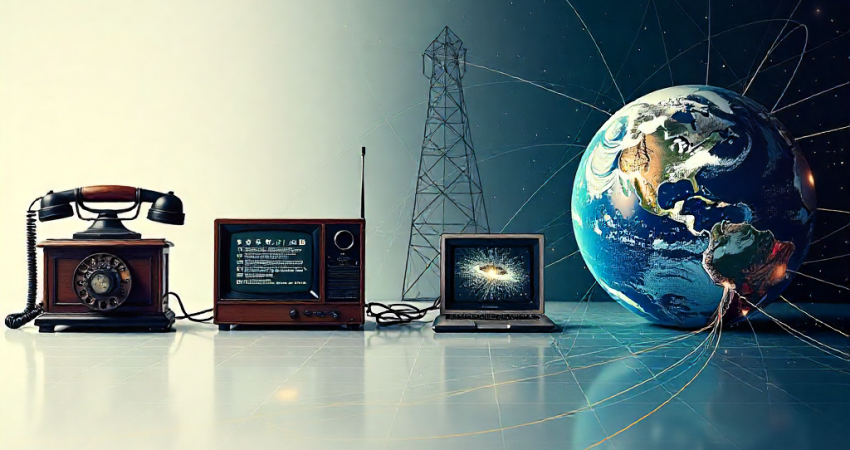
The Evolution of Communication: From Telegraphs to Fiber Optics
Imagine a world where a message to a loved one overseas took months to arrive by ship. A world where business negotiations across continents were glacial, and global news was, by definition, old news. This was the reality for most of human history.
The journey to our modern era of instant, global connection is a story of relentless innovation. It’s a tale that transformed not just how we talk, but how we live, work, and perceive the world. Let's trace the fascinating evolution of communication from the first electrical sparks to the light-speed fibers that power our lives today.
The Spark: The Telegraph and the Death of Distance
In the mid-19th century, the invention of the telegraph was nothing short of revolutionary. Pioneered by Samuel Morse and others, it used electrical pulses to transmit encoded messages (Morse code) over wires. For the first time, information could travel faster than a human or a horse.
- The Impact: The telegraph shrank the conceptual size of nations. It revolutionized news reporting, business, and military strategy. The famous first message, "What hath God wrought?" was a prophetic question hinting at the profound change it would unleash.
The Human Voice Takes Flight: The Telephone
While the telegraph was powerful, it was limited to trained operators. Alexander Graham Bell’s invention of the telephone in 1876 changed the game entirely. It transmitted the human voice itself, making communication intuitive, personal, and emotional.
- The Impact: The telephone created a direct, personal connection across distances. It moved communication from the public office (the telegraph) into the home. The sprawling networks of telephone lines and switchboards became the literal nervous system of the 20th century.
Wireless Wonders: The Radio and Broadcast Era
The next great leap was cutting the cord. Guglielmo Marconi's successful experiments with radio waves proved that information could be transmitted through the air, without physical wires. This gave birth to radio broadcasting, and later, television.
The Impact: Radio created mass media. A single voice could now reach millions simultaneously, unifying countries through news and entertainment. It was the dawn of the "broadcast" era, a one-to-many model that would define media for decades.
The Digital Dawn: The Internet and Packet Switching
The foundations of our modern world were laid with the development of computers and a new method of data transmission: packet switching. Instead of a dedicated circuit (like a phone call), information was broken into small "packets," sent independently across a network, and reassembled at the destination.
This robust, decentralized system was the core of ARPANET, the precursor to the Internet. When combined with the creation of the World Wide Web by Tim Berners-Lee, which gave us browsers and websites, the digital revolution went mainstream.
The Impact: The internet shifted communication from one-to-many (broadcast) to many-to-many. It democratized information, created email, instant messaging, and eventually, social media. The world was now a interconnected digital web.
Going Mobile: The Smartphone in Your Pocket
The logical next step was to untether the internet itself. The development of cellular networks, evolving from 1G (voice-only) to 5G (high-speed data), combined with the power of the personal computer, led to the smartphone.
The Impact: We now carry a powerful communication device in our pockets. It’s a telephone, a telegraph (texting), a radio (streaming), a television, and a portal to the global internet—all in one. Communication became truly personal, portable, and perpetual.
The Speed of Light: The Fiber Optics Backbone
So, how does all this data travel across oceans and continents at near-instant speed? The answer is fiber optics. This technology uses pulses of light sent through incredibly pure glass or plastic fibers thinner than a human hair.
- Why It's a Game-Changer:
- Immense Bandwidth: A single fiber optic cable can carry thousands of times more data than a traditional copper wire.
- Incredible Speed: Data travels at the speed of light, with minimal loss over long distances.
- Reliability: It’s immune to electrical interference and is incredibly secure.
Fiber optics is the unsung hero of our connected age. It’s the physical backbone that makes high-speed internet, global video calls, cloud computing, and streaming 4K video possible. It’s the highway on which all our digital communication now travels.
The Future is Already Here
The evolution hasn't stopped. We are now entering the era of the Internet of Things (IoT), where machines communicate with each other, and 5G/6G networks promise even lower latency and higher speeds, enabling advancements like autonomous vehicles and augmented reality.
From the simple click of a telegraph to the silent flash of light in a glass fiber, the journey of communication is a testament to human ingenuity. Each breakthrough has collapsed time and space a little more, weaving us into an ever-tighter global community. It’s a story that reminds us: the most powerful connections we make are not between devices, but between people.
